
Short answer: a lab grown diamond is a real diamond, pure crystallized carbon, identical to a mined diamond in every physical and chemical property. Moissanite is a different gemstone altogether, silicon carbide, that looks diamond-like at first glance but handles light, wear, and grading differently. Moissanite costs less. A lab grown diamond is a diamond. Which one is right depends on what you actually want on your hand for the next few decades.
They are not two versions of the same thing
Shoppers often treat moissanite and lab grown diamonds as two versions of the same thing. They are not: they are different gemstones with different chemistry, different sparkle, and different grading standards. Let's clear that up first.
A lab grown diamond has the same crystal structure, hardness, brilliance, and chemistry as a mined diamond. The only difference is origin: it grows in a controlled facility over weeks instead of in the earth over eons. Gem labs grade it on the same 4Cs scale as mined diamonds, and it tests as diamond because it is diamond.
Moissanite is silicon carbide (SiC). Natural moissanite is vanishingly rare, so essentially all moissanite in jewelry is lab made. It is a legitimate gemstone in its own right, not an imitation glass. But it is not a diamond, and a trained eye, or a simple electrical tester, can tell them apart.
Side by side
| Property | Lab grown diamond | Moissanite |
|---|---|---|
| Material | Carbon (diamond) | Silicon carbide |
| Hardness (Mohs) | 10 | 9.25 to 9.5 |
| Brilliance (refractive index) | 2.42 | 2.65 to 2.69 |
| Fire (dispersion) | 0.044 | 0.104 |
| Light behavior | Single refraction, crisp white sparkle | Double refraction, strong rainbow flashes |
| Grading | Full 4Cs report (IGI, GIA) | No standardized 4Cs grading |
| Price | Higher | Lower |
The light tells you which is which
Moissanite's higher dispersion means it throws noticeably more rainbow-colored light than a diamond. Some people love this. Others find it artificial-looking, especially in larger stones, where the effect is strong enough that it has a nickname: the disco ball effect. Moissanite is also doubly refractive, which means light splits in two inside the stone. Look closely through the top of a larger moissanite and the back facets can appear doubled, a slight blurriness a diamond never has.
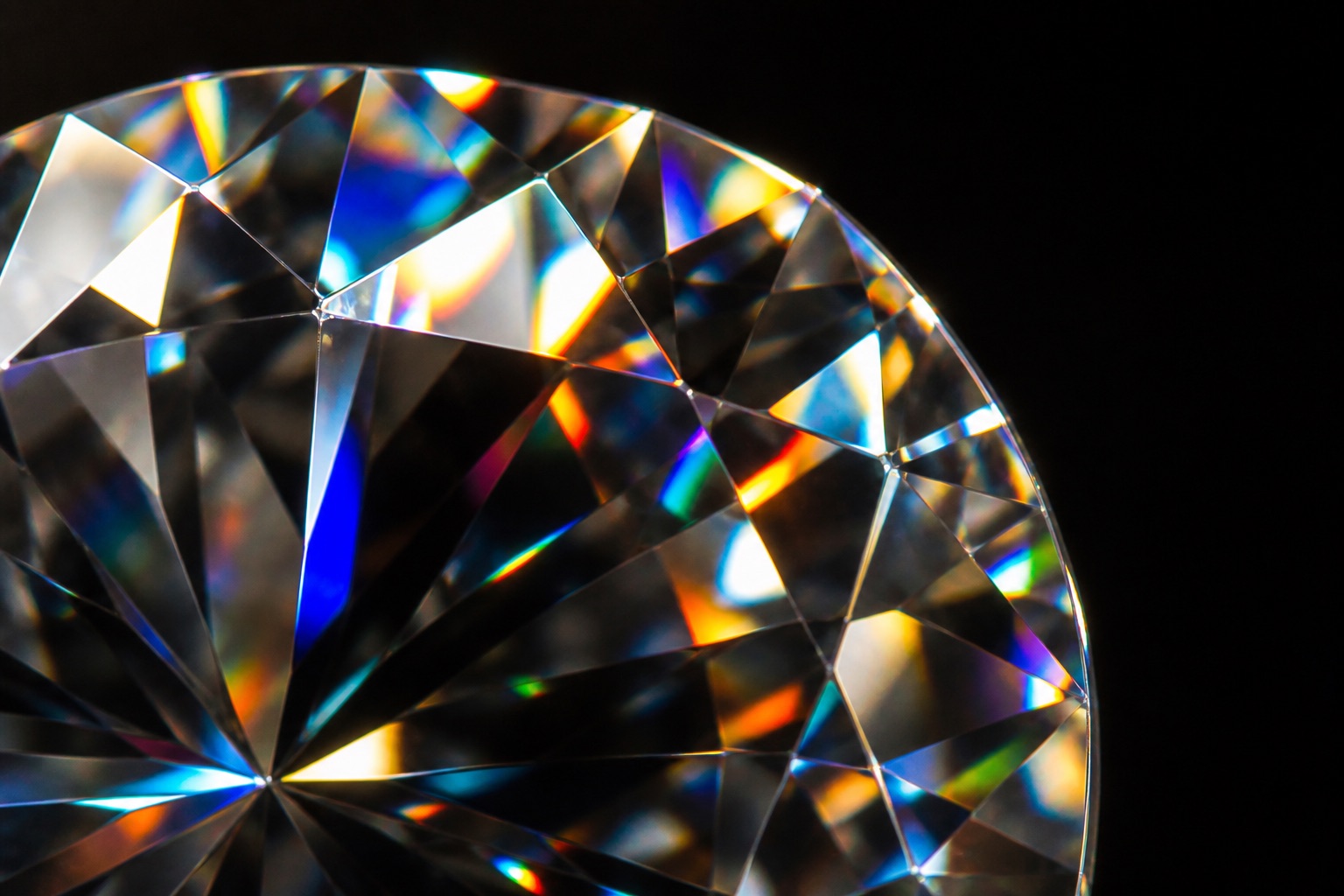
A diamond's sparkle is a balance of white light and restrained fire, which is exactly what most people picture when they picture a diamond. If someone will be looking at this stone every day for years, the difference matters more than it does in a photo.
Durability over decades
Both are hard enough for daily wear, and moissanite is harder than sapphire or any other common gem except diamond. But diamond's hardness of 10 is not one step above moissanite's 9.25, because the Mohs scale is not linear: diamond is several times harder in absolute terms. Over decades of daily wear, that gap shows up as facet edges that stay crisp versus edges that slowly soften. An engagement ring is a decades-long purchase, which is why we think durability deserves more weight than it usually gets.
Grading and resale honesty
A lab grown diamond of 1 carat or more comes with an independent IGI report documenting its color, clarity, cut, and carat weight, and you can verify the report number online. Moissanite has no equivalent standardized grading system, so "premium" moissanite means whatever the seller says it means. That does not make moissanite a bad product. It does mean you are relying on the brand rather than an independent lab.
So which should you choose?
Honestly:
- Choose moissanite if budget is the deciding factor and the rainbow-heavy sparkle appeals to you. It is a reasonable choice, and pretending otherwise would be salesmanship.
- Choose a lab grown diamond if you want an actual diamond: the look, the hardness, the independent grading, and the fact that you never have to qualify what it is. Lab grown pricing has made that choice far more accessible than it used to be, especially in the larger carat weights and fancy colors where mined stones are out of reach for most budgets.
FAQ
Can anyone tell moissanite from a diamond? At a glance, often not. In person over time, frequently yes, from the rainbow-dominant sparkle and, in bigger stones, the doubled facets. Any jeweler with an electrical tester can tell in seconds.
Does moissanite pass a diamond tester? It passes basic thermal testers, which is why it is sometimes misrepresented. Electrical conductivity testers identify it correctly.
Is a lab grown diamond "fake" compared to a mined one? No. It is chemically, physically, and optically identical to a mined diamond. Gem labs grade both on the same scale. The distinction is origin, not substance. We cover this in depth in lab grown vs natural diamonds.
Does moissanite get cloudy over time? Quality moissanite does not permanently cloud, though like any stone it dulls with skin oils and needs regular cleaning. Older or lower-grade material can show a slight green or gray tint in some light.
Explore the collection
Browse lab grown diamond engagement rings from $999, or read how to choose a lab grown diamond to pick the 4Cs that matter for your budget.


